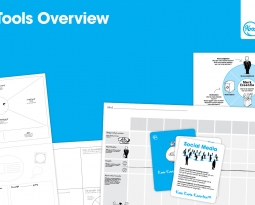
Koos is pleased to offer a special section of easy to use DIY service design tools. To get an idea of what tools we offer at the moment, check out our blog ‘tools overview‘.
1. Workshop dynamics
Workshops are meant to be special sessions in which the ‘normal’ hierarchies and structures don’t apply. In a workshop setting everyone is expected to contribute with his or her own expertise. Criticism should be postponed, and ideas of others should be built upon. Have people present their results to each other and discuss them. One of the main goals of every workshop is to come to a shared understanding on a certain topic and discussion is essential to that.
2. Facilitator
A good workshop has an experienced facilitator who has some distance to the workshop’s challenge and who understands and has experience with workshop dynamics.
3. Diverging, clustering, converging
There are three distinct stages in most workshops:
a. Diverging stage: generating many ideas, without criticising them, freely associating and building on each other’s input.
b. Clustering stage: in which the generated outcomes are organised and structured,
c. Converging stage: in which criteria are formulated, choices are made and ideas or solutions are specified and detailed. These three stages are different in character and should be treated accordingly by the facilitator (eg: diverging: no criticism, open atmosphere, converging: more strict and structured)
4. Group size
The ideal workshop group size is 6 people. If the group gets bigger, it’s best to divide it in smaller teams, but this requires extra logistics and facilitation.
5. Group expertise
The ideal workshop group consists of people with diverse expertise and backgrounds. Adapt the group to the theme of the workshop and get specialists involved. Don’t be afraid of opposing characters or backgrounds. If you explain the rules well these should lead to better results.
6. Facilities
Make sure the workshop is conducted in a room with enough daylight and fresh air, water, food, paper, felt pens, post-its etc. It can really help if you can organize a break out session to a different room or location.
7. Time
Make sure that the workshop doesn’t last too long. Some time pressure helps to get to the point quickly and to not fall back into daily routines. If you organise a full day workshop, make sure to include an excursion, a good lunch and maybe some kind of inspiring entertainment.
8. Plan
Make a detailed workshop plan. The more detailed you make it, the easier it will be to improvise if something doesn’t quite run according to plan. Plan each exercise in terms of input, expected actions and expected output. Allow for sufficient time for presentation and discussion between exercises.